Quartz Surface Guide
Quartz Kitchen Islands
Quartz kitchen islands worktops can be made to fit any size base units, maximum slab lengths must be considered for both quartz and other stone surfaces for either a quartz island or peninsula.
Visit quartz worktops to learn about quartz and discover colours.
Last updated:26 March 2026
Benefits of Quartz Kitchen Islands & Peninsulas
Any kitchen spacious enough to accommodate a quartz kitchen island or peninsula can take advantage of a variety of bespoke features ideal for those investing in new worktops or looking to elevate their current design.
Breakfast bars, waterfall end panels and edge profiles are all bespoke features that can enhance the look and feel of your quartz kitchen.
Benefits of a Kitchen Island or Peninsula
Also, incorporating a sink or a hob in a spacious island can make for easier food preparation or free up valuable worktop space.
Island Or Peninsula?
Peninsulas differ to quartz kitchen islands in only a few ways. Islands are separate from all other worktops. Peninsulas being more a focal point to a kitchen, in most cases (material dependent), is always the fuller worktop piece, where the worktop runs up to and joins with it. Peninsula option opens a couple of bespoke options such as choice between upstands or splashbacks.
Quartz Island Size, Shapes & Curves
Your island or peninsula can be any size, however, there are limitations on slab sizes that may impact the look of a quartz kitchen island.
There are methods to fabricate a larger island if it exceeds the slab size and will require an additional slab of material. If the island or peninsula top is larger than 3 - 3.2 metres, a center join would be the best way to achieve balance and symmetry
Thickness
Most quartz surfaces are available in 2cm and 3cm thicknesses, slab thickness do have an impact on cost. 2cm is strong enough for quartz kitchen island overhangs for breakfast bars, standardised at 300mm before additional support is required for safety reasons. Island or peninsulas that have mitred drop edges / boxing, we suggest that 2cm thickness is sufficient because the slab profile is hidden.
Quartz Slab Sizes
Considerations on island size must include your choice of stone work surface material, and the maximum slab size that it is available in. Not all slabs are available in the larger Jumbo Format size, and although they only differ by 10cm to 30cm, the extra provided has a vast impact on the possibilities, and will substantially affect cost.
Engineered quartz material brands vary with their manufactured slab sizes:
Standard: 1400mm x 3000mm
Large: 1500mm x 3200mm
Jumbo: 1600mm x 3200mm
Super Jumbo: 2000mm x 3500mm
Sizes are approximate and quartz slab sizes vary according to design groups set by each brand.
Shapes and Curves
Most quartz kitchen islands are rectangular and parallel to the worktops, or as a peninsula, it will sit proud of an 'L-shaped' or 'U-shaped' kitchen as a divider to a living or dining space. Curved corners are becoming increasingly popular, and follow the curve of the units underneath. Bespoke radius curves for nearby doors, or for children safety are also considerations. Quartz is versatile and as long as it fits and can be cut on the CNC machine, you can have any shape you like.
NOTE: Shapes and curves on a quartz island or peninsula top are not suitable in combination with end panels, drop edges and boxing.
Quartz Island Weight & Access
An average sized 30mm thick quartz island could weigh up to 500kg (half a tonne), so it is important to ensure that any non-standard supporting units are able to take on this weight. Access to the location of the island or peninsula must also be considered to safely transport and install. Our templating team will assess access on the day of templating and also consider other access concerns, such as parking and lifting to upper floors of a flat. All these factors should be taken into account prior to the templator arriving to site, to avoid later disapointment.

Mitred & Butt joints
Mitred joins are a higher end finish compared to butt joints because it allows the pattern on the stone to follow down the edge profile or waterfall edge.
Apart from waterfall ends and edge profiles, mitred or butt joints are used mostly when making deeper looking furniture to increase the overall depth.
Mitred End panels
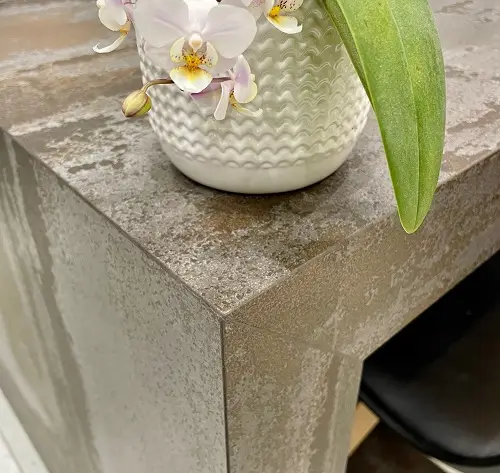
End panels are a superb design extra for the end of an exposed worktop length, or on one or both ends of an island as a wrap. The continuation of a worktop into a waterfall (end panel) can look amazing in any stone worktop material. If you have chosen to opt for a waterfall end, it may be prudent to opt for a mitred join to help with any vein matching, or the ever more luxurious 'book matched vein finish'. It is important to note that unless you have a quartz island of 2 metres with one end panel, additional material will be required.
Mitred or Butt Joints
Joins with angles, most predominantly end panels or boxed islands, can be joined in two ways. A 'butt joint' is where the worktop rests on top of the vertical end panel. In most applications, especially worktop designs that do not require vein matching, a butt joint is more than sufficient. Mitre joining is where both pieces are cut at a 45 degree angle and joined together. This method makes the end panel and worktop appear as one piece. Mitre joining is most welcomed for an elaborate finish when vein and book matching.
Natural Stone Profile Edges
Sometimes the quartz crystal grains can make mitre joins less crisp, however, this is ok if you want rounded profile edge. It may be prudent to consider 3cm thickness for opulent natural quartzite and marble. We always advise of pros and cons of each material during consultation.
NOTE: Just like any other name and modern terminology, end panels have been re-named by those who wish to make them sound more sales-worthy; names such as 'drop sides', 'downstands' and 'waterfall ends' etc...
Book / Vein matching
All stone surface materials, both natural and man-made can be used for vein and book matching.
Book matching is achieved by aligning 2 slabs of material from the same block together.
The resulting symmetry is what is called book matching (butterfly join). This symmetry sparks within us a recalling of facial recognition called pariedolia. All stone surface materials, both natural and engineered stone can be used for vein and book matching. A waterfall edge island worktop with continuous veining is the most commonly fabricated vein matched kitchen island.
Book Matching
Book matching requires minimum 2 full slabs of material. Book matched island tops are best made from quartz, porcelain or natural marble for strength, consistency and patterning. It is without a doubt that if you are looking for something real - natural marble would be your best buy. Quartz materials provide excellent options on colours and designs ideal for vein and book matching kitchen islands.
Vein Matching
Vein matching works best for waterfall end panels and splashbacks where the cut is made with care so that veins follows from the worktop and on to the panel. We suggest if 2 end panels are desired, that one end is selected as a preference as vein matching 2 end panels may prove a challenge due to material requirements. It is essential to set a little bit of time to ensure that the look you are after is possible with preffered materials and to fit your budget.
Both book match and vein matching can also be used for splashbacks on peninsulas, end panels, drop edge profiles, boxing and so on...
Breakfast Bars
The standard unsupported overhang for breakfast bars in any worktop material is 300mm; therefore extra support maybe required for overhangs that exceed this depth.
Care must be taken when deciding on overhang depth as any support, for aesthetic purposes, would be better hidden from sight.
Concealed support for larger overhangs can include downstands (drop edge profiles of approx are 50-150mm), end panels, and cross support bars (running across base units underneath worktop). Other supports may include breakfast bar legs, brackets and marine ply as an overall support; however, these do come with challenges of finding ways to obscure the support. It is advised that you speak with us for advice on how support can be administered.
Drop Edges and Boxing
Boxing involves either butt or mitre joins to increase the appearance of an edge profile known as a drop edge.
Drop edges are also known as downstands (opposite to upstands standardized at 100mm), they are most commonly used to increase the overall depth appearance of the kitchen island or peninsula. We advise that 20mm thickness materials are used for quartz kitchen islands with drop edges, and that they are mitre joined for that single piece look.
Boxing
Drop edges can be made as deep a profile as preferred; very effective at 150mm around the perimeter of the island, or joined at 45 degrees to 150mm sides that wrap around to make end panels appear boxed. It must be noted, however obvious, that drop edges, overlays and boxed finishes do not combine well with radius corners or curves.
Overlays
Overlays using a 12mm thickness quartz are likely to need drop edges to increase the depth appearance and cover the underlying base worktop surface or ply base if used instead of a worktop.
Edge Profiles
Depsite the large range of edge profiles that can be used, modern approaches to kitchen worktops prefer clean flat edges, allowing focus on the overall look of a kitchen.
Of late only a few profile edges have been requested such as, bullnose, half rounded, 'ogee' and 'dupont'. Most edge profiles require a worktop depth of 30mm or doubling up the edge for a more elaborate look. As 20mm has become the more popular option, the choice has reduced accordingly. Despite all, a profile edge increaes worktop costs, and is more vulnerable to knocks and chips.
Sink, Hob & Extractor
A benefit of relocating a sink and quartz drainer to the island from a worktop length is the space that is saved for food preparation.
All sink types can be used with quartz countertops. Ceramic and Stainless steel sink with integrated drainer grooves. Undermount sinks and butler sinks allow for drainer grooves to be cut into the worktop to drain water into the sink. An integrated stone sink for a seamless kitchen aesthetic if made from the same quartz material as the worktop.
A kitchen island with sink or a hob cut into it works best if the island is of a suitable size; the process involved with fabricating is much the same as adding a sink to a worktop run. A benefit of relocating a sink and quartz drainer to the island from a worktop length is the space that can be saved for food preparation. The largest thing to consider is the plumbing work that would need to be carried out. Hobs added to quartz kitchen islands, again, is much the same as cutting for a standard worktop length, but is benefitted by having the space for an extractor behind it, which for us is an additional cut out. Options for ventilation of steam are plenty, and include pop-up, downdraft, and ceiling-mounted overhead hoods. Positioning sinks and hobs should be considered carefully if in combination with a breakfast bar, as additional support maybe required leading to an expense that can be avoided during planning.